
Extech Tech Tips: pH and ORP

In water testing and maintenance work, chemical water conditions directly affect system performance, treatment results, and equipment reliability. Visual checks or experience alone often make it difficult to detect changes quickly. pH and ORP meters provide a fast, on-site way to check current water conditions—helping users confirm whether conditions are staying within an expected range at the time of measurement.
Some applications only require pH measurement, others rely more on ORP, and many use both together to gain a clearer operating picture. Below, we explain what pH and ORP measure—and why they matter in practical field testing.
pH describes whether water is acidic or alkaline, using a scale from 0 to 14, with pH 7 considered neutral. Lower values indicate higher acidity, while higher values indicate increased alkalinity.
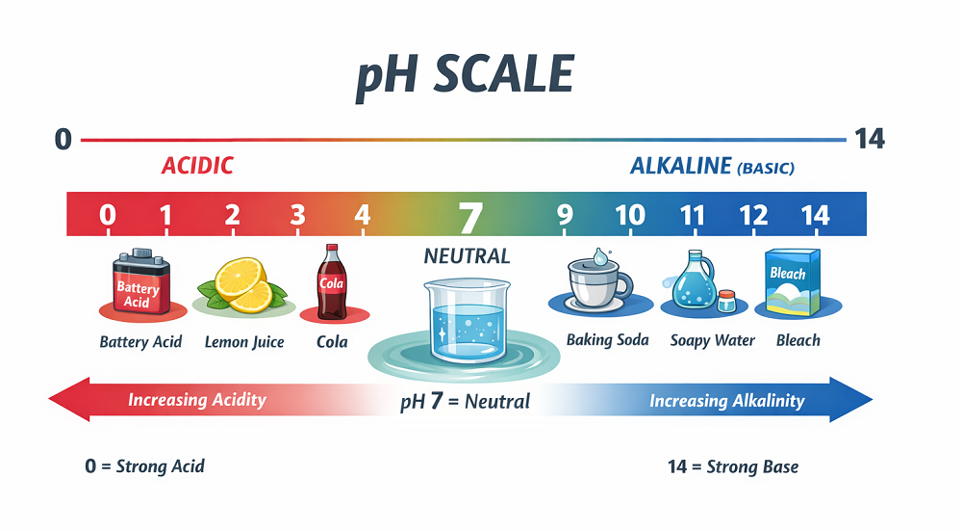
pH is one of the most commonly measured water quality parameters because it provides a quick snapshot of overall chemical conditions. A simple pH check helps confirm whether water remains within an acceptable operating range for the application. It is also important to note that pH is measured on a logarithmic scale. A change of just one pH unit represents a tenfold difference in acidity. For example, water at pH 6 is ten times more acidic than water at pH 7. Even small pH shifts can contribute to process problems, system inefficiencies, or equipment issues, which is why routine pH monitoring is a fundamental part of many water-related applications.
ORP (Oxidation-Reduction Potential) indicates whether a solution is in a more oxidizing or reducing condition. ORP is measured in millivolts (mV) and reflects overall redox activity rather than the concentration of a single chemical.

ORP does not mean “higher is always better.” Instead, it helps confirm whether the system’s redox condition matches what the application requires at that moment.
pH and ORP meters are commonly used as fast field tools for routine checks, troubleshooting, and on-site verification.
Regardless of configuration, the goal is the same: fast, actionable insight for on‑site decision‑making.
pH and ORP meters are widely used in field environments where quick, on‑site evaluation is required. Depending on the application, users may focus on pH, ORP, or use both together to gain the most relevant insight into water or process conditions.
Extech designs pH and ORP meters around how measurements are actually made in the field—from quick checks to routine maintenance and on-site verification. The lineup includes pH meters, ORP meters, and combination meters to match different application needs.
The ExStik® II Series reflects this field-focused approach. Its flat surface electrode supports measurements in liquids, semi-solids, and solid surface samples, while helping reduce common issues such as probe breakage and clogged junctions in non-lab environments.
To learn more about Extech’s pH and ORP measurement solutions, click here